


Quick Search

Cognitive Function and Left/Right Judgment Performance in Individuals with Chronic Neck Pain: A Cross-sectional Comparative Study
Ayşegül Bostan1, Bedia Özdemir Turgut2, Ayşenur Akan3, Özlem Ülger41Department of Physiotherapy and Rehabilitation, Bahçeşehir University Faculty of Health Sciences, İstanbul, Türkiye; Department of Physiotherapy and Rehabilitation, Hacettepe University Faculty of Physical Therapy and Rehabilitation, Ankara, Türkiye2Department of Physiotherapy and Rehabilitation, İstanbul Arel University Faculty of Health Sciences, İstanbul, Türkiye
3Research Institute for Health Sciences and Technologies (SABITA), Istanbul Medipol University, Istanbul, Türkiye
4Department of Physiotherapy and Rehabilitation, Hacettepe University Faculty of Physical Therapy and Rehabilitation, Ankara, Türkiye
INTRODUCTION: Neck pain (NP) is associated with impaired cognitive function and altered neck awareness; however, its impact on implicit motor imagery performance, assessed by the left/right judgment task (LRJT), remains unclear. This study compared LRJT performance, cognitive function, and neck awareness between patients with NP and pain-free controls.
METHODS: This cross-sectional comparative study included 35 patients with NP and 35 matched pain-free controls. Cognitive function was assessed using the Montreal Cognitive Assessment (MoCA), neck awareness using the Fremantle Neck Awareness Questionnaire (FreNAQ), pain levels by the Visual Analog Scale, and LRJT performance using the Recognize® application.
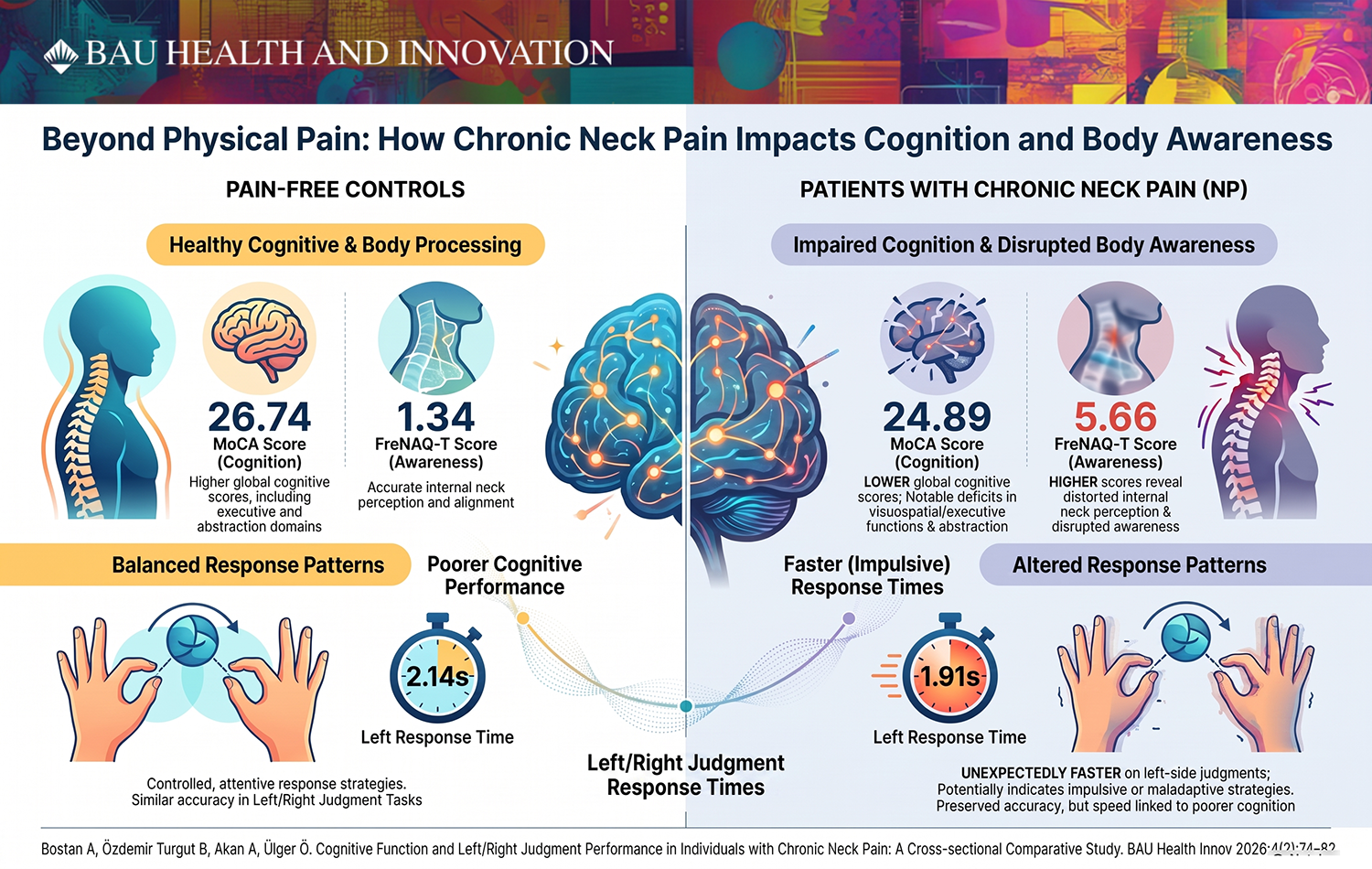
RESULTS: Patients with NP had significantly lower MoCA scores and higher FreNAQ scores compared to controls (p<0.05). LRJT accuracy and right response time did not differ between groups; however, left response time was significantly shorter in patients with NP (p<0.05). A significant negative correlation was observed between MoCA scores and left response time in patients with NP (r=-0.391, p=0.020).
DISCUSSION AND CONCLUSION: These results indicate that chronic NP is associated with reduced cognitive function and altered neck awareness, while overall LRJT performance may remain preserved. The observed association between cognitive function and response time suggests that cognitive capacity may influence lateralized motor judgment processes in individuals with chronic NP. Consideration of cognitive function may therefore be important when interpreting LRJT outcomes in this population.
Keywords: Cognitive performance, implicit motor imagery, left-right judgment task, neck pain.
Graphical abstract
Manuscript Language: English